
South Goa Beaches Guide: Palolem, Agonda or Cola - Which One Is Yours?
The honest south Goa beaches comparison for solo female travellers, couples, and first-time visitors: Palolem, Agonda, and Cola matched to your trip, with real costs, solo safety notes, olive ridley turtle season, and the right order to do all three.
By Prerna, Nomira
You've narrowed it down to three south Goa beaches: Palolem, Agonda, and Cola, and now you're a dozen browser tabs deep and none of them tells you which one is right for the trip you're actually about to take. They all describe the same postcard features. They never tell you which beach matches your mood, your budget, or your travelling companion.
That's because most south Goa beach guides describe places. This one matches them to trips.
Palolem, Agonda, and Cola sit within a 25-kilometre stretch of the Canacona coast, Goa's southernmost taluk, where the road loses patience with concrete and the beach hut economy still runs on seasonal wood and tidal goodwill. They are three different answers to three different questions. The Instagram crowds never quite made it this far south. The real coast: clifftop sweeps, silent sand, a boulder maze around a freshwater lagoon, stayed quietly down here.
By the end of this guide you will know which of the three is yours, and exactly why the other two are not.
For international travellers new to Goa: this is India's smallest state, on the country's west coast. The south Goa beaches in this guide are in the Canacona belt, the quietest and least commercial stretch of the entire Konkan coastline. If you have flown into Mopa airport (GOX) or Dabolim (GOI), you are 90 minutes to two hours from all three beaches by taxi.
Palolem vs Agonda vs Cola: South Goa Beaches at a Glance
Before the detail, the complete comparison in one scannable table. Screenshot this before you leave for the beach, mobile signal in the Canacona belt is unreliable once you leave the main road.
| Beach | Best for | Length | Vibe | Nightly cost (peak season) | Skip if |
|---|---|---|---|---|---|
| Palolem | Solo travellers, backpackers, first-time Goa visitors | 1.5 km crescent | Social, active, fairy-lit evenings | ₹800 to ₹2,500 huts (~$10 to $30) | You want silence or zero nightlife |
| Agonda | Couples, solo women, wellness travellers, families | 3 km wide arc | Calm, slow, quality-led | ₹2,000 to ₹9,000 cottages (~$24 to $108) | You need variety of activities or nightlife |
| Cola | Photographers, off-grid travellers, returning Goa visitors | Twin cove, small | Remote, cinematic, one mood | ₹4,000 to ₹15,000 eco-resorts (~$48 to $180) | You need dining variety or easy road access |
Peak season: Mid-November to mid-March | Nearest rail: Canacona station (3 km from Palolem) and Madgaon/Margao junction (45 km, serves all three) | Between-beach transport: Scooter ₹300 to ₹500/day ($4 to $6), or boat from Agonda to Cola ₹1,500 to ₹2,500 return ($18 to $30)
Why the South Goa Coast Starts Here, and Not at Baga
The southern coast of Goa curves down from Colva and Cavelossim into the Canacona belt, and then the character of the coast changes completely. North Goa is louder, more commercial, and more famous, Baga, Calangute, Anjuna are built for a different kind of trip and do it well. The south is where the coastline keeps its character.
What preserves the Canacona beaches is structural. Beach huts come down every monsoon and are rebuilt each October, no permanent commercial structures, by state regulation and local convention. Fishing boats still pull in catch at dawn. The villages behind the sand still depend on the sea. You will see paddy fields from the beach and hear roosters from your hut. These are not selling points: they are what's left when commerce hasn't fully arrived.
The beaches in south Goa, and specifically the trio of Palolem, Agonda, and Cola in the Canacona belt, are where serious travellers come when they want Goa without the version of Goa that ends up on every travel influencer's grid. That quiet is still the default here. It won't be forever.
The Three South Goa Beaches in Detail
Same structure for each: who it's for, what you do, what you give up, safety notes for solo female travellers, where to stay, what it costs, and how to reach it.
Palolem Beach: South Goa's Social Hub
The character shows up before you reach the sand. Walk down Palolem road from the bus stand and you hear music a hundred metres before the beach opens up, a 1.5 km crescent rimmed by tall coconut palms, with a clifftop sweep at the northern end and a small green island swimmable at low tide. The energy is sociable rather than rowdy. Beach huts on stilts. Boat-trip touts in the morning. Yoga shalas in the late afternoon. Fairy-lit cafés at night.
This is the south Goa beach for solo travellers, backpackers, friend groups, first-time Goa visitors who want activity without North Goa's club scene, and young couples on a budget. If you want to meet other travellers, you will, within an hour of arriving.
What you do at Palolem
The activity range is the widest of the three. Dolphin and Butterfly Beach boat trips run ₹300 to ₹1,250 per person (~$4 to $15), go with a local boatman rather than a larger operator. Kayaks rent for around ₹300 an hour. Yoga drop-ins are easy at half a dozen shalas. The cliff walk south to Patnem takes twenty minutes and rewards you with a quieter beach for lunch. Saturday nights in season bring Silent Noise Club, a headphone disco on the beach with three music channels, no speakers, entry ₹800 to ₹1,000. It is the only silent disco on the south Goa coast and worth planning a Saturday night around.
Things to do in south Goa don't get more concentrated than Palolem: every activity on this list is walkable or available within 10 minutes by scooter.
What you give up at Palolem
Peace at sunset, the beach is busy from four to seven and the café row hums well past ten. Mains at the better cafés run ₹300 to ₹600 (~$4 to $7). You will not have a stretch of sand to yourself at any point in peak season.
Solo female travel note, Palolem
Palolem is one of the most solo-female-friendly beaches in south Goa, precisely because the volume of travellers creates social safety. The hut row is lit, the cafés keep visible hours, and the beach is never isolated. For the wider picture, our solo female travel in India safety guide sets out the habits worth carrying onto any beach. There are always other women travelling alone in peak season. Reported annoyances are mostly the same as any busy tourist beach: touts on the sand in the morning, occasional unsolicited conversation. Walk with intention and you will be left alone.
Night: the fairy-lit stretch between the main hut row and the café strip is safe and social. Solo women have been navigating Palolem after dark for twenty years. The cliff path to Patnem at night is a different matter, take it in the evening before dark, not after.
One thing Palolem gets right that most guides skip: if anything goes wrong, motorbike, theft, illness, Palolem has the infrastructure to help. There are two pharmacies on Palolem road, an ATM, and a police outpost 800 metres from the beach. No other beach in this guide has all three.
Where to stay and what it costs at Palolem
Seasonal beach huts (bamboo and palm-thatch structures rebuilt each October) ₹800 to ₹2,500 a night in season. Guesthouses set back from the beach ₹1,500 to ₹3,500. A handful of small hotels further along Palolem road. Almost everything closes June through September. Budget traveller doing one activity a day and eating mid-range: ₹1,500 to ₹3,500 per person per day in season.
How to reach Palolem
Train to Canacona station, 3 km away, auto-rickshaw or taxi to beach (₹80 to ₹150). Or Madgaon/Margao station, 45 km, the bigger junction, 40-minute taxi (₹700 to ₹900). From Mopa airport (GOX): approximately 100 km, 1.5 hours, ₹2,000 to ₹2,500 by taxi. From Dabolim airport (GOI): approximately 65 km, 1 hour 10 minutes, ₹1,200 to ₹1,800. A scooter from anywhere in Goa works once you are in the state.
Agonda Beach: South Goa's Quietest Major Beach
Eight kilometres north of Palolem, Agonda opens up: a 3 km arc of soft sand, no permanent commercial sunbeds, no jet-skis, almost no boat traffic on the water. A single low-rise village street runs parallel to the beach, cafés, boutique stays, yoga studios, two Ayurveda clinics, and that is the complete commercial offer.
The northern end of the beach is fenced by the Goa Forest Department through the Olive Ridley nesting season, protecting one of the most active sea turtle nesting sites in the state. According to the Forest Department's 2024 nesting records, Agonda recorded 181 nesting events that season, a figure that reflects how undisturbed this stretch of coast remains.
This is the beach for couples wanting genuine intimacy, wellness travellers pursuing a yoga or Ayurveda week, readers and writers, and returning Goa visitors who came back disappointed by busier beaches. Agonda has a word-of-mouth reputation that precedes it: people who stayed here once tend to book it first the second time.
What you do at Agonda
From November to March, the Forest Department marks the nesting area at the northern end of the beach and a volunteer is sometimes present at dawn to walk visitors through the observation protocol. Drop-in yoga is easy at half a dozen shalas on the village street; rates run ₹500 to ₹800 a class (~$6 to $10). Agonda-based operators run day trips to Butterfly Beach, a 90-minute return walk in dry months, or a short boat ride. The sunset stretch of the beach, from the southern end to the central café cluster, is among the best evening walks in south Goa, 3 km of wide soft sand with almost no one on it after five o'clock.
Things to do in south Goa at the slower end of the spectrum is exactly what Agonda excels at. There is no wrong way to spend a day here.
What you give up at Agonda
Nightlife, there is essentially none. And Palolem's range of cheap activity options. Cafés here are quality-led, not budget-led: mains run ₹400 to ₹900 (~$5 to $11), which is correct for what you receive but will surprise travellers arriving from Palolem expecting the same price bracket.
Solo female travel note, Agonda
Agonda is one of the most consistently recommended beaches in south Goa among solo female travellers, mentioned more often in Nomira's community than any other Canacona beach. The village is small enough to feel attentive without being intrusive. The café cluster on the village street creates a natural social anchor for solo travellers who want to be around people without committing to a crowded scene.
The beach itself is wide enough that you can find complete solitude at either end while remaining visible from the centre. Evening walks on the sand feel safe by Agonda's own conventions: the community is small, the faces become familiar quickly, and the tourist-to-local ratio stays balanced even at peak.
Practical note: the village street has two cafés that solo women specifically name as reliable social anchors with staff who are attentive without being intrusive. The Ayurveda clinics are properly run, not a shorthand for anything else. If you want the quietest, most considered beach experience on this coast, Agonda is the answer.
Where to stay and what it costs at Agonda
Barefoot-luxury beach cottages ₹3,500 to ₹9,000 a night in season ($42 to $108), boutique guesthouses ₹2,000 to ₹4,000 ($24 to $48), a handful of full-resort options slightly inland. A couple eating well and doing one activity a day: ₹3,000 to ₹6,500 per person per day in season.
How to reach Agonda
Thirty-minute taxi from Madgaon (₹700 to ₹900). Around two hours from Mopa airport (GOX). A 25-minute scooter ride from Palolem on the coast road, the simplest option if you are sequencing the three beaches.
Cola Beach: South Goa's Most Rewarding Detour
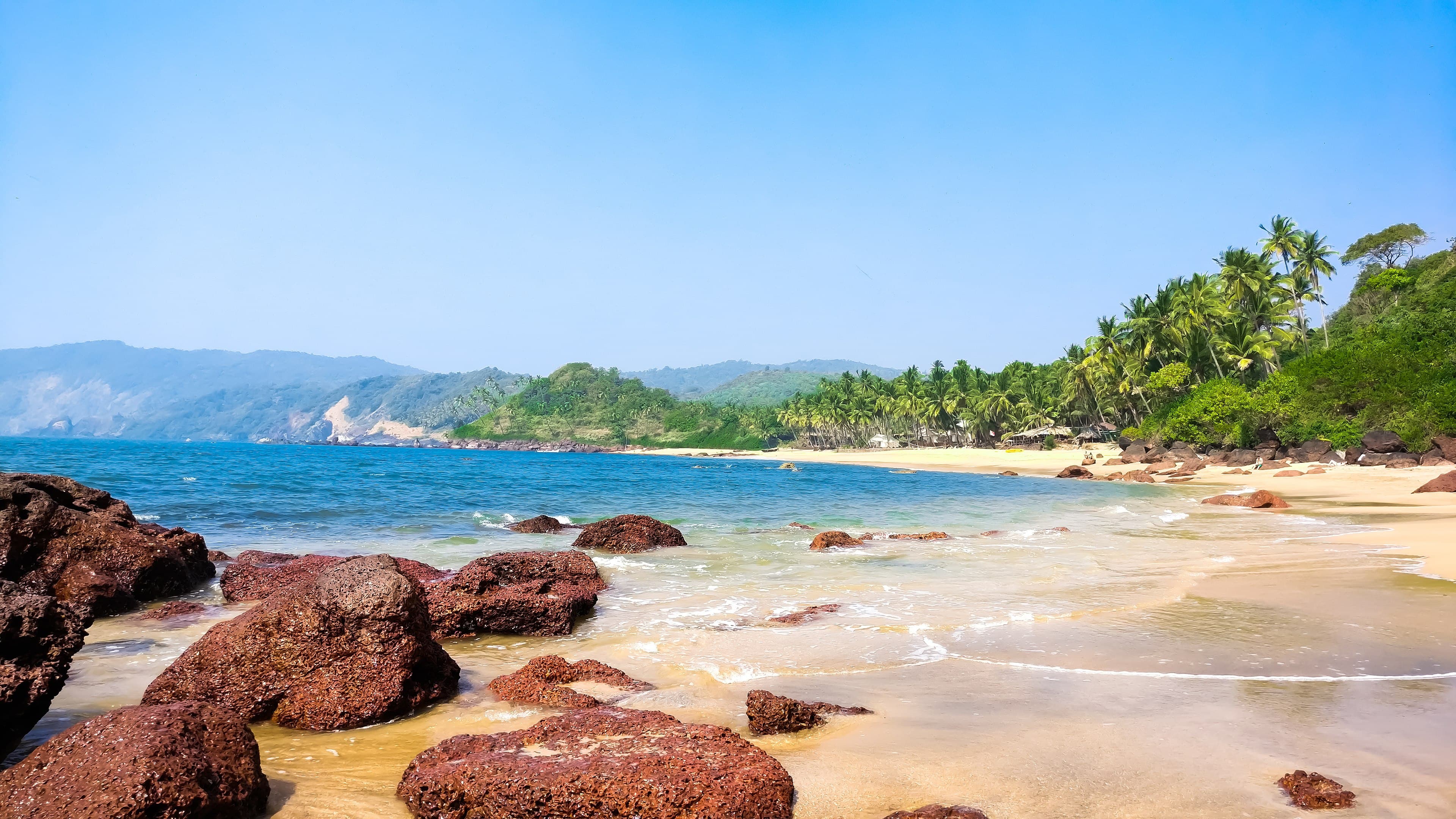
Cola is two beaches pretending to be one. A small twin cove, Big Cola and Little Cola, split by a rocky outcrop and framed by red laterite cliffs and palm groves. The signature feature is the freshwater lagoon: a small river behind the beach breaks through the sand to meet the sea, and the lagoon holds through the dry months. Boulders pile up at the headlands and turn the cove into a low-tide maze that rewards an afternoon of scrambling.
The light here, late afternoon, those red cliffs, that green lagoon, the sea behind, is the most cinematic of the three beaches. There is a reason every photographer who comes to south Goa eventually finds their way to Cola.
This is the beach for photographers, off-grid romantics, slow travellers, and returning Goa veterans who have exhausted the better-known options. It rewards the willingness to trade convenience for landscape.
What you do at Cola
You swim the lagoon. You scramble the boulder maze at low tide. You kayak between the two coves, rentals run ₹100 to ₹150 an hour when available. You watch the sunset from the south headland, which frames both the sea and the lagoon in the same view. You read in the afternoon when the light drops.
Day-trippers leave by five o'clock, and after that the place is entirely yours. Staying overnight is not just the practical choice, it is when Cola becomes the place people describe when they come home.
What you give up at Cola
Access, dining range, and variety. There are a handful of resort restaurants and one or two beach cafés. No pharmacy. No ATM. No reliable UPI. This is one mood, repeated, for as many days as you choose to stay, which is exactly right if that mood is the one you came for, and exactly wrong if it isn't.
Solo female travel note, Cola
Cola requires more independent preparation than the other two beaches, because the infrastructure that creates passive safety, lit streets, populated café strips, a pharmacy nearby, simply does not exist here. That is not a safety problem; it is a preparation problem.
Arrive in daylight. Tell someone your itinerary. Carry enough cash for your entire stay (the nearest ATM is in Agonda). Most eco-resorts at Cola are small, owner-managed properties where you will be known by name within an hour of checking in, which is actually a form of safety that Palolem's anonymity does not provide. Several women solo-travelling to Cola specifically choose it because the close-knit resort environment is more comfortable than a crowded beach hut row.
The boat from Agonda (see below) removes the isolation of the road and is the recommended approach.
Where to stay and what it costs at Cola
Low-rise eco-resorts and tented camps ₹4,000 to ₹15,000 in season (~$48 to $180), with a handful of high-end options approaching ₹40,000. There is almost no reliable budget hut option at Cola, the economics of the rough road do not favour cheap beds. A couple or solo traveller: ₹4,500 to ₹9,000 per person per day, mostly because you eat where you sleep. Book well in advance, Cola has the fewest beds of the three beaches and fills early in December.
How to reach Cola
Two ways, and the choice matters. The road is an 8 km laterite track off NH-66 from the Agonda direction, manageable by scooter or small car in dry season, but the last 2 km is rough enough to test your suspension and your luggage. The better option: a 25-minute boat from Agonda beach for ₹1,500 to ₹2,500 return (~$18 to $30), which removes the dirt road entirely and arrives you at the beach from the sea, the correct first view of Cola. Most repeat visitors take the boat every time.
Which South Goa Beach Is Right for Your Trip? The Decision Guide
Pick by the trip you are taking, not the traveller you want to be on Instagram. The version of you who reads all weekend at Cola is real, but only if you actually read all weekend.
| You are | Pick | Minimum nights |
|---|---|---|
| A solo female traveller wanting safety + social options | Palolem | 2 nights |
| A solo female traveller wanting quiet + community feel | Agonda | 3 nights |
| A couple wanting calm, yoga, good food | Agonda | 3 nights, one night is not enough to slow down |
| A backpacker on ₹1,500 to ₹3,500 a day | Palolem | 2 nights |
| A photographer or slow traveller chasing landscape | Cola | 2 nights, one night and you haven't arrived |
| A family with young children | Agonda | 3 nights |
| A first-time Goa visitor with 5 days | All three, Palolem → Agonda → Cola | 1 to 2 nights each |
| A returning visitor who has done Palolem | Agonda and Cola | 2 nights each |
| A traveller who needs nightlife to justify a beach week | Neither, go to Anjuna or Vagator | Those beaches do that trip well |
A permission note to close this table: if the vibe at your chosen beach feels wrong on day one, all three beaches in south Goa are within 90 minutes of each other by scooter. Switch. The whole point of this coast is that you have options without burning a travel day.
Why Families With Young Children Should Choose Agonda Over Palolem
Agonda's 3 km arc has the gentlest slope of the three beaches, the safest swimming for small children. The village street is compact enough to walk end-to-end with kids in tow. Palolem's boat scene and surf are genuinely fun for adults, but the water gets pushy by mid-afternoon and the hut row gets loud by evening. Cola's laterite road and boulder terrain are not suited to children under five, skip the Cola leg entirely in that situation.
When to Visit South Goa Beaches, Turtle Season, and How to Sequence All Three
The main season window
Mid-November to mid-March. Daytime temperatures 28 to 32°C, low humidity, full hut economy open across all three beaches. December 20 to January 5 is the price spike, Agonda cottages book out six weeks in advance at peak-season rates. Shift to early December or late January for the same quality at 20 to 30% lower prices and a noticeably quieter beach.
The shoulder windows
Late October and late March each give you roughly 70% of the main-season experience at around 30% lower prices. Some hut clusters are still being constructed in October or already dismantled in late March, confirm with specific properties before booking.
The monsoon (June to September)
All three beaches are dramatically beautiful and largely inaccessible. Huts are gone, fewer than half the cafés stay open, and swimming is officially banned at all three. June through August brings 700 to 800 mm of rainfall. This is a different trip entirely, for return visitors who want to see the coast in a different mode. Inland Goa, by contrast, peaks in the rains: see our guide to the best places to visit in India during monsoon for the Dudhsagar Falls circuit.
Olive Ridley turtle nesting at Agonda
Olive Ridley sea turtles nest at the northern end of Agonda and at Galgibaga beach from late November through March, with hatchlings emerging between January and April. According to the Goa Forest Department's 2024 nesting records, Agonda recorded 181 nesting events that season, making it one of the most active sea turtle nesting beaches in the state.
The rules are not suggestions: no flash photography at any stage, never touch or pick up a turtle, stay at least five metres back from any nest or hatchling, no phone torches directed at the sea. This is active wildlife conservation on an open beach, not a managed tourist attraction.
Walk the Forest Department-marked area quietly at dawn between November and March. If a volunteer is present, they will show you the observation protocol. You will see something that the majority of visitors to Goa, including those who have been three times, have never witnessed.
The correct sequence for all three beaches
For a 3-to-5-day trip covering all three south Goa beaches, the order matters. Palolem first, then Agonda, then Cola. Energy descends rather than ascends, which is how the body wants to spend a beach week. Starting with the highest activity level and ending at the quietest and most remote means you decompress gradually. Running it in reverse leaves Palolem feeling harsh and loud after Cola's silence.
Suggested pacing: Palolem 1 to 2 nights (arrive, find your feet, do the boat trip). Agonda 1 to 2 nights (decompress, eat well, dawn turtle walk if in season). Cola 1 to 2 nights (take the boat from Agonda, skip the road, and stay long enough for at least one afternoon after the day-trippers leave).
Six Things That Separate a Good South Goa Trip From a Frustrating One
1. Book Cola accommodation well in advance. Cola has the fewest beds of the three beaches and in peak season the eco-resorts fill fast. Palolem and Agonda have enough huts and cottages that a walk-in usually finds something, Cola does not. If Cola is on your itinerary, lock in accommodation before you arrive in Goa.
2. Take the boat to Cola, not the road. The 8 km laterite track is manageable in dry season but the last 2 km is rough, and arriving by sea, the lagoon, the cliffs, the twin cove opening up as you approach, is the better first impression by a significant margin. The round-trip boat from Agonda runs ₹1,500 to ₹2,500 (~$18 to $30) and takes 25 minutes each way. Worth every rupee.
3. Carry cash in small notes. UPI works at established restaurants on the Agonda village street and at some Palolem cafés, but it disappears the moment you step onto a beach or into a hut. Cola has no ATM and no reliable UPI at all, arrive with enough cash for your entire stay. The nearest ATM to Cola is in Agonda. For all three beaches in south Goa, the working rule is: cash first, assume UPI as a bonus.
4. Don't try to do all three beaches in under three days. Two nights and three beaches means you never slow down enough to experience any of them. Three nights minimum for the full trio, five if you have them. One night at Cola specifically is not enough, the place requires at least one afternoon after the day-trippers leave to reveal itself.
5. Rent a scooter, not a taxi. Scooters run ₹300 to ₹500 a day (~$4 to $6) and give you the flexibility to move between the beaches in south Goa when you want, stop at the Cabo de Rama fort viewpoint between Agonda and Palolem, and explore the paddy-field interior that no taxi driver will take you to unbidden. For international travellers: Indian traffic is denser and less rule-bound than most Western road environments, give yourself one low-stakes morning ride before attempting the Madgaon highway. Before you sign a rental agreement, read the scooter-hire section of our India tourist scams guide, which covers exactly what to check.
6. In monsoon, reverse the sequence. If you are a return visitor doing the monsoon trip, start at Cola (least infrastructure to miss), move to Agonda (most monsoon-dramatic and still partly open), end at Palolem (most reliably open, easiest exit). The monsoon sequence is the mirror image of the dry-season one.
What Does a South Goa Beach Trip Cost?
Realistic per-person per-day breakdown for each beach in peak season (mid-November to mid-March). Rupee prices are primary; dollar equivalents approximate at ₹83 to $1.
| Beach | Accommodation | Food (3 meals) | One activity | Daily total |
|---|---|---|---|---|
| Palolem, budget | ₹800 to ₹1,500 | ₹600 to ₹900 | ₹300 to ₹500 | ₹1,700 to ₹2,900 (~$20 to $35) |
| Palolem, mid-range | ₹1,500 to ₹2,500 | ₹900 to ₹1,800 | ₹500 to ₹1,250 | ₹2,900 to ₹5,550 (~$35 to $67) |
| Agonda, mid-range | ₹2,000 to ₹4,000 | ₹1,200 to ₹2,000 | ₹500 to ₹800 | ₹3,700 to ₹6,800 (~$45 to $82) |
| Agonda, premium | ₹4,000 to ₹9,000 | ₹1,500 to ₹2,500 | ₹800 to ₹1,500 | ₹6,300 to ₹13,000 (~$76 to $157) |
| Cola, eco-resort | ₹4,000 to ₹8,000 | ₹1,500 to ₹2,500 (on-property) | ₹100 to ₹500 | ₹5,600 to ₹11,000 (~$67 to $133) |
5-day all-three-beach trip, per person, mid-range: ₹3,000 to ₹5,500/day average (~$36 to $66)
Scooter rental adds ₹300 to ₹500 per day if shared between two. The Cola boat transfer is a one-off ₹750 to ₹1,250 per person each way. Bring ₹3,000 to ₹5,000 in cash to Cola for the full stay.
Key Takeaways
- The three south Goa beaches answer different questions: Palolem for company and activity, Agonda for calm and quality, Cola for landscape and silence.
- With five days, do all three in the order Palolem, then Agonda, then Cola, so energy descends and the quiet arrives at the end.
- All three sit within 25 km of each other in the Canacona belt, so switching beaches costs at most 90 minutes by scooter, not a travel day.
- Palolem is the safest first stop for solo female travellers: it is the only one of the three with a pharmacy, ATM, and police outpost within 800 metres.
- Take the 25-minute boat from Agonda to Cola rather than the 8 km laterite road, and book Cola first because it has the fewest beds.
- Peak season is mid-November to mid-March; carry cash everywhere because UPI is unreliable across all three south Goa beaches.
- At Agonda, olive ridley turtles nest from late November to March (181 nesting events recorded in 2024): walk the marked area at dawn, no flash, five metres back.
South Goa Beaches: Frequently Asked Questions
Which is better, Palolem, Agonda or Cola beach in South Goa?
They are three different answers to three different questions, not three points on a quality scale. Palolem is the right pick for company, activity, and budget, boat trips, a lively sunset scene, and the widest range of huts. Agonda is the right pick for couples, solo women, and wellness travellers, wide soft sand, yoga studios, quality cafés, no nightlife. Cola is the right pick for photographers and off-grid travellers, a freshwater lagoon, red laterite cliffs, a boulder maze, and very limited beds. Pick by the trip you are actually taking.
Is Palolem Beach safe for solo female travellers?
Yes, Palolem is one of the most solo-female-friendly beaches in south Goa. The density of travellers creates passive safety: there are always other women travelling alone in peak season, the hut row is lit, and the café strip is visible and populated at night. Reported issues are typical of any busy tourist beach, early-morning touts, occasional unsolicited conversation. Walk with intention and you will be left alone. Palolem also has the best emergency infrastructure of the three Canacona beaches: two pharmacies, an ATM, and a police outpost within 800 metres of the beach. For a solo female traveller's first night in south Goa, Palolem is the correct starting point.
Is Agonda Beach safe for solo female travellers?
Agonda is consistently the top-rated beach on the south Goa coast among solo female travellers in Nomira's community. The village is small enough to feel attentive without being intrusive, faces become familiar quickly, and the café cluster on the village street creates a natural social anchor. The beach itself is wide enough for complete solitude at either end while remaining visible from the centre. The Ayurveda clinics are properly run. Solo women who want quiet without isolation name Agonda more often than any other beach in the Canacona belt.
What is the best time to visit south Goa beaches?
Mid-November to mid-March: 28 to 32°C, low humidity, full hut economy open. December 20 to January 5 is the price spike, book six weeks ahead or shift to early December or late January for the same quality at better prices. Late October and late March are quieter shoulder windows with approximately 30% lower accommodation costs. The monsoon (June to September) closes the hut economy and bans swimming.
How do I get to Cola Beach, South Goa?
Two options. The road is an 8 km laterite track off NH-66 from the Agonda direction, manageable by scooter in dry season, but rough for the last 2 km. The better option is a 25-minute boat from Agonda beach for ₹1,500 to ₹2,500 return (~$18 to $30), which removes the road entirely and delivers you to the beach from the sea, the correct first view. Most repeat visitors take the boat every time.
Can I see Olive Ridley turtles at Agonda Beach?
Yes. Olive Ridleys nest at the northern end of Agonda from late November through March; hatchlings emerge January to April. The Goa Forest Department recorded 181 nesting events at Agonda in the 2024 season. Walk the marked area at dawn. No flash, no torch directed at the sea, no touching turtles, five metres minimum from any nest or hatchling. This is active wildlife conservation on an open beach, treat it accordingly.
Is south Goa good for families with young children?
Agonda is the best choice for families with young kids, it has the gentlest beach slope and the safest swimming of the three beaches, plus a compact village street that is easy to navigate with children. Palolem's afternoon surf gets pushy and the evenings get loud. Cola's laterite road and boulder terrain are not suited to children under five, skip the Cola leg if that is your situation.
How much does a south Goa beach trip cost?
Budget at Palolem: ₹1,700 to ₹2,900 per person per day ($20 to $35). Mid-range at Agonda: ₹3,700 to ₹6,800 ($45 to $82). Eco-resort at Cola: ₹5,600 to ₹11,000 ($67 to $133). A five-day trip covering all three averages ₹3,000 to ₹5,500 per person per day at mid-range ($36 to $66), including scooter rental and the boat transfer to Cola. Carry cash, UPI is unreliable at all three beaches once you leave the main road.
What is the best order to visit Palolem, Agonda, and Cola?
Palolem first, then Agonda, then Cola. Energy descends rather than ascends, which is how the body wants to spend a beach week. Running it in reverse leaves Palolem feeling jarring after Cola's silence. For a 5-day trip: Palolem 1 to 2 nights, Agonda 1 to 2 nights, Cola 1 to 2 nights. Take the boat from Agonda to Cola, skip the road.
Where should I stay in south Goa, beach hut or guesthouse?
At Palolem, seasonal beach huts (₹800 to ₹2,500) are the practical default in season, they are the experience, not just accommodation. At Agonda, beach cottages (₹2,000 to ₹9,000) and boutique guesthouses (₹2,000 to ₹4,000) give you the better stay. At Cola, eco-resorts and tented camps (₹4,000 to ₹15,000) are essentially your only option, there is no reliable budget hut economy on that road. Book Cola well in advance.
The Bottom Line: Three South Goa Beaches, One Decision, Done Right
Palolem for company. Agonda for calm. Cola for landscape. If you have the days, do all three in that order, energy descending, quiet arriving at the end. If you have to pick one, the decision table earlier was built for the trip you are actually taking, not the one you want to photograph.
The infrastructure is creeping in a little more every season. The road to Cola is being graded. Boutique stays at Agonda are climbing past ₹10,000. Each year the quiet costs a little more or starts a little later. The beaches in south Goa that remain genuinely un-commercial are doing so on borrowed time, not because they will be ruined, but because the world has begun to notice them.
Go now, while the quiet is still the default rather than the marketing pitch.
Related Reading
- Best places to visit in India during monsoon, for the inland Goa and Dudhsagar Falls circuit when the beaches close.
- India tourist scams guide, for scooter-hire checks and the Canacona road variants before you sign anything.
- Solo female travel in India safety guide, the habits worth carrying onto any beach in the country.
- Konkan coast road trip, where these south Goa beaches sit on the wider Konkan coastline.
- India travel tips for first-time visitors, the groundwork for a first trip that includes Goa.
Quick answers
Frequently asked questions
Free resource
The Solo Female India Pre-Trip Checklist — free.
What to install before you land, how to vet a guesthouse in 60 seconds, 4 Hindi phrases that stop scams, and what to share with someone back home before every travel day. One email. No spam.
Destination dossier
Goa
India
Where to stay
Assagao
Anjuna / Vagator
Scam alerts
Fake hotel/villa booking online
Members only
Neighbourhood scores, scam alerts, transport tips, emergency contacts — all in one dossier.
₹1499 / 6 months ≈ $18 / £14
Also on Nomira
Keep reading
Related stories you'll like

Best Solo Female Travel Apps India (2026 Tested)
The best solo female travel apps for India in 2026, compared honestly by the founder of one of them: safety intel, buddy matching, women-only verification, and what each app actually costs solo travellers.
The best solo female travel apps for India in 2026, compared honestly by the founder of one of them. Safety intel, buddy matching, women-only verification, and real data on what solo women actually report.
By Prerna, Nomira

Khajuraho Travel Guide: The 90% of Carvings Nobody Tells You About
A Khajuraho travel guide built around the 90% of temple carvings nobody photographs: how to read the walls, all three temple groups, real costs in INR and USD, and a one-to-three-day plan.
The Khajuraho temples hold around 30,000 carvings, but only 10% are erotic. This guide covers all three temple groups, how to read the walls, costs in INR and USD, and a two-day plan built for women travellers.
By Prerna, Nomira

Jim Corbett National Park: Which Zone Actually Has Tigers?
A Jim Corbett National Park guide built around the one decision that shapes your whole safari: zone choice. Honest tiger sighting odds for all six zones, the 45-day booking system explained, real costs in INR and USD, and which zone to book for your dates.
Jim Corbett National Park has six safari zones with very different tiger sighting odds. This guide gives honest odds for Dhikala, Bijrani, Jhirna, Dhela and Durga Devi, explains the 45-day booking system, lists real costs in INR and USD, and tells you which zone to book for your dates.
By Prerna, Nomira

Rameswaram Travel Guide: Why Nobody Stays Past the Temple
This rameswaram travel guide pairs Ramanathaswamy temple darshan with Dhanushkodi, the ghost town 18 km east wiped out overnight by the 1964 cyclone. The temple is the first act. The edge of India is the second. Here is the 36-hour version worth flying for.
Rameswaram is the Char Dham temple town every Tamil Nadu itinerary mentions in one line. This rameswaram travel guide pairs Ramanathaswamy temple darshan with Dhanushkodi, the ghost town 18 km east wiped out overnight by the 1964 cyclone, into a 36-hour trip worth flying for.
By Prerna, Nomira

Haridwar Travel Guide: The Town Every Rishikesh Visitor Skips
This haridwar travel guide covers one perfect day in India's oldest active pilgrimage city. Ganga Aarti timing at Har Ki Pauri, the Bara Bazaar food crawl, Daksheshwar Mahadev, and the exact sequence that slots Haridwar into any Rishikesh trip in under sixteen hours.
Haridwar sits 25 km downstream from Rishikesh and holds a Ganga Aarti that is older and denser than any upstream equivalent. This haridwar travel guide covers one perfect day: hill temples at Mansa Devi and Chandi Devi, the Bara Bazaar food crawl, Daksheshwar Mahadev, and the Ganga Aarti at Har Ki Pauri at sunset.
By Prerna, Nomira